Trump Backs CFTC Authority Over Prediction Markets
Trump Backs Federal Oversight of Prediction Markets, Doubles Down on Crypto
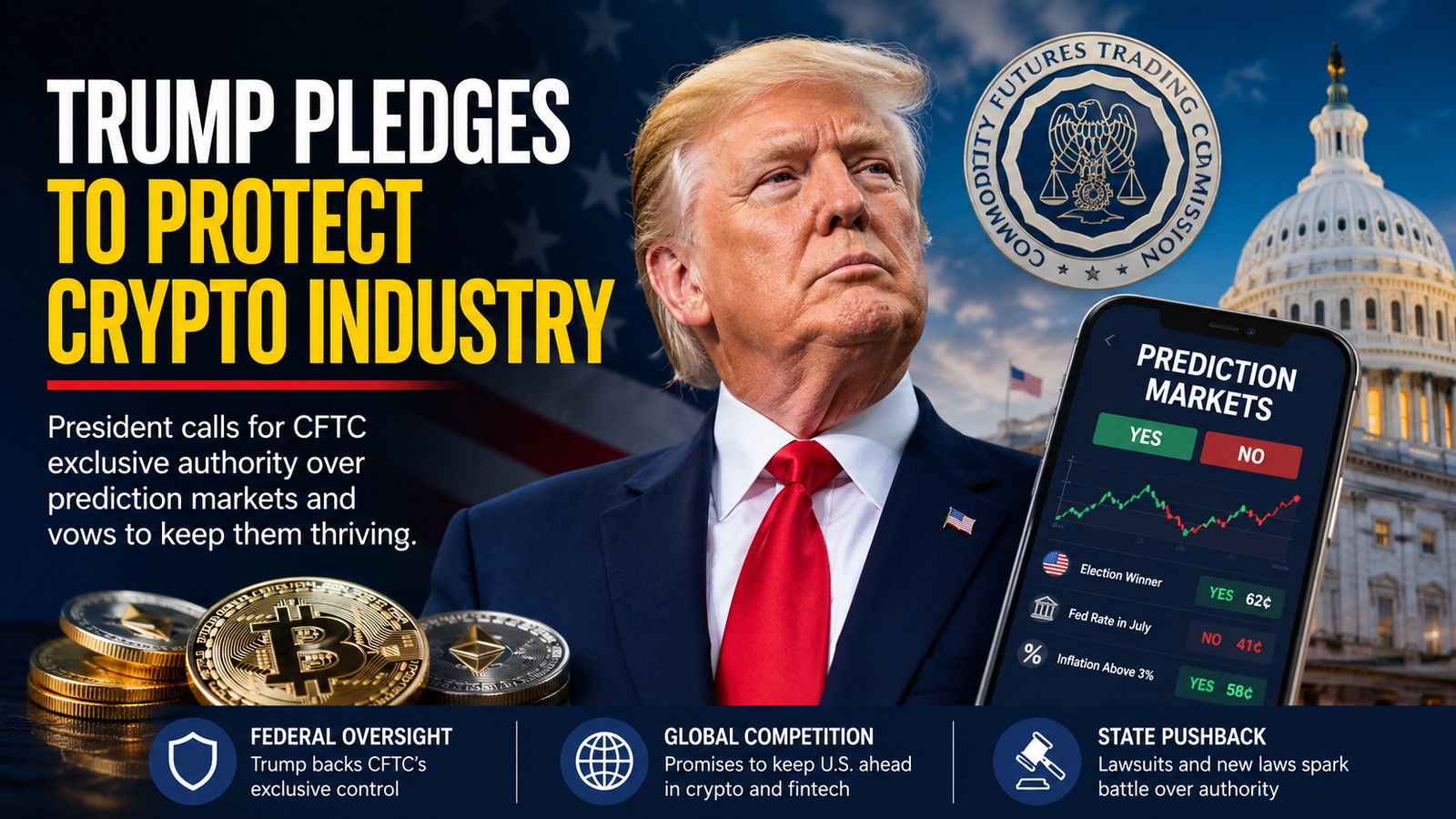
President Donald Trump has reiterated his support for both the cryptocurrency industry and prediction markets, arguing that federal regulators should retain sole authority over event-based trading platforms.
In a post shared Tuesday on Truth Social, Trump said it is essential for the Commodity Futures Trading Commission (CFTC) to remain the primary regulator of prediction markets. He emphasized that these platforms should be allowed to expand under a clear federal framework.
According to Trump, his administration is developing what he described as a model regulatory structure that could serve as a benchmark for states across the country. He also stressed the need for the United States to remain competitive as other nations attempt to establish themselves as leaders in emerging financial technologies.
Trump further highlighted the country's position in the digital asset industry, stating that the United States currently leads the global cryptocurrency market. He warned that foreign competitors are actively seeking to challenge that dominance and pledged to prevent the nation from losing its advantage.
Growing Conflict Between Federal and State Regulators
The president's comments came shortly after a New York Times investigation examined the CFTC's approach to regulating prediction markets and digital assets. The report alleged that the agency has supported the expansion of prediction markets while easing oversight of certain cryptocurrency activities. It also suggested that staffing changes within the commission reduced the influence of career regulators.
The debate carries additional attention because Trump and members of his family maintain business interests connected to both industries. Among those ventures is World Liberty Financial, a cryptocurrency company associated with the Trump family.
Donald Trump Jr. has also been linked to Kalshi and Polymarket, two of the most recognizable companies operating in the prediction market space.
As prediction markets continue to grow, they face increasing legal challenges from state governments. Several states argue that these platforms function similarly to gambling operations and therefore should be subject to state gaming regulations rather than federal oversight.
The central issue is whether authority over prediction markets belongs exclusively to the CFTC or whether individual states have the right to regulate them under their own gambling laws. The dispute has become a major policy battle in Washington and in state capitals nationwide.
States Push Back Against Prediction Market Expansion
Supporters of stronger state involvement, including governors and attorneys general from both major political parties, contend that event contracts, particularly those tied to sports outcomes, are effectively a form of betting and should be treated like casinos, lotteries, and other gaming activities.
Minnesota recently became the first state to pass legislation specifically targeting prediction market operators. Governor Tim Walz signed a measure last week that would prohibit such platforms from operating within the state. In response, the Trump administration filed a lawsuit seeking to affirm the CFTC's authority over the industry.
Trump criticized Walz in his Tuesday statement and also pointed to several state officials who have pursued regulatory action against prediction markets this year. Among them was New York Attorney General Letitia James, a longtime political and legal adversary of the president.
James recently filed legal actions against cryptocurrency companies Coinbase and Gemini, alleging that their prediction market offerings amounted to gambling activities within New York. The companies dispute that claim, maintaining that they operate under federal regulatory oversight and are not subject to state-level control in this area.
With lawsuits, legislation, and regulatory challenges mounting, the future of prediction markets may ultimately depend on court decisions determining whether federal agencies or state governments hold primary authority over the rapidly evolving sector.